
Getting four and five-year-olds outside and moving doesn’t require elaborate equipment or a degree in early childhood education. The best outdoor games for this age group are simple, last 10 to 20 minutes, and build on skills they’re already developing: running, throwing, balancing, and taking turns.
At this age, children are mastering basic motor skills but still learning to follow multi-step rules. They thrive on repetition, love imaginative play, and need games where everyone wins sometimes. That’s why classics like Red Light, Green Light and Duck, Duck, Goose remain staples. They work because they match where preschoolers actually are developmentally.
The games you’ll find here require minimal setup. Most need nothing more than a ball, some chalk, or objects you already have at home. Each game takes less than five minutes to explain, and kids can start playing right away. No complicated scoring systems, no waiting in long lines, and no need for teams of exactly equal skill levels.
What makes a game genuinely appropriate for four and five-year-olds? It keeps them moving without requiring sustained focus for more than a few minutes at a time. It has clear, visual cues rather than complex verbal instructions. And it allows for the beautiful chaos that comes with this age group, where someone will inevitably make up their own rules halfway through or decide to be a dinosaur instead.
The eight games ahead have been tested by real parents and educators working with preschoolers. They keep kids engaged, burn energy, and actually get easier to manage the more you play them.
Why These 8 Games Work Best for Preschoolers
Four and five year olds exist in a sweet spot where they’re bursting with energy but still building the foundations of physical control. Their attention spans hover around 5-10 minutes for structured activities, they’re just mastering skills like hopping on one foot and catching a large ball, and they’re learning what it means to wait for a turn. The games in this article were chosen specifically because they match where your preschooler actually is right now, not where you wish they were.
Each game addresses multiple developmental needs at once. When a child plays Red Light, Green Light, they’re not just running, they’re practicing impulse control, processing verbal directions quickly, and learning to manage their body’s momentum. Animal walks build core strength and bilateral coordination without feeling like exercise. These aren’t watered-down versions of games for older kids; they’re purposefully designed for the capabilities and needs of 4-5 year olds.
Safety was a non-negotiable selection factor. You won’t find games requiring precise aim at other children, complex equipment, or movements that risk injury for still-developing joints. Shadow tag eliminates collision risks. Parachute play teaches cooperation without winners and losers. Every game includes natural moments to rest, which matters when little bodies tire quickly but don’t always recognize it.
The social component matters just as much as the physical one. At this age, children are moving from parallel play to genuine interaction. These games introduce the concept of rules in forgiving ways, create opportunities to cheer for friends, and let kids experience both following and leading without high-pressure competition.
1. Red Light, Green Light, Learning Self-Control While Running
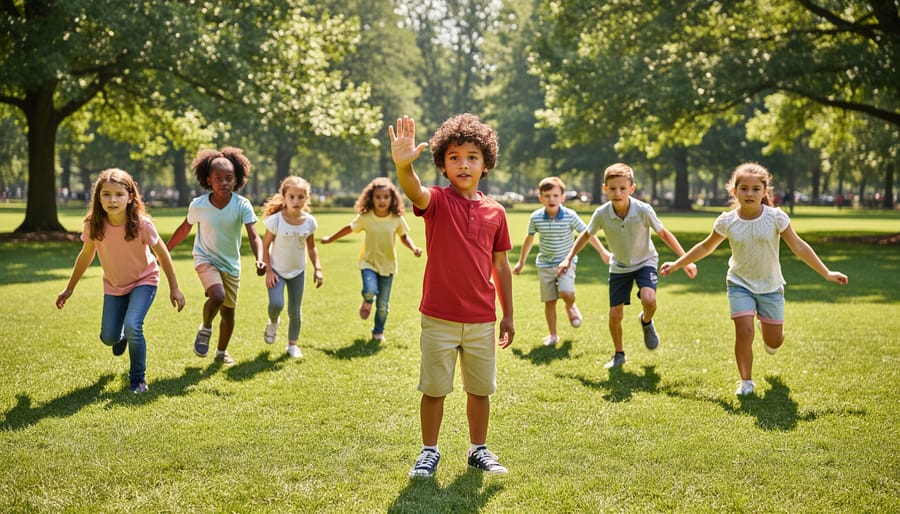
Red Light, Green Light turns impulse control into an exciting race. One person stands at the finish line as the “traffic light” while everyone else lines up at the starting point about 20 feet away. When the traffic light calls “Green light!” players run forward. At “Red light!” everyone must freeze immediately. Anyone still moving goes back to the start. The first player to reach and tag the traffic light wins and becomes the new traffic light.
This game is perfect for 4 and 5 year olds because stopping on command requires exactly the kind of body control they’re developing right now. They’re learning to override their impulse to keep running, which strengthens executive function skills they’ll use in every part of life. The rules are simple enough that most kids grasp them after watching one round, and the quick turnover keeps attention spans engaged.
Set up requires nothing but outdoor space. A driveway, backyard, or park works equally well. Mark your start and finish lines with cones, chalk, or natural landmarks like trees. Keep the distance short enough that rounds finish in under a minute, about 15-20 feet works best for this age.
To keep everyone engaged, swap the traffic light role frequently so no one waits too long. Let kids be silly with how they freeze (balance on one foot, make funny poses). You can also build vocabulary outdoors by calling colors, animals, or action words instead of “red” and “green.” For easier play, give a warning (“Red light coming!”) before stopping. For more challenge, face away from players when calling commands so they can’t anticipate the call.
2. Animal Walks Obstacle Course, Building Strength Through Play
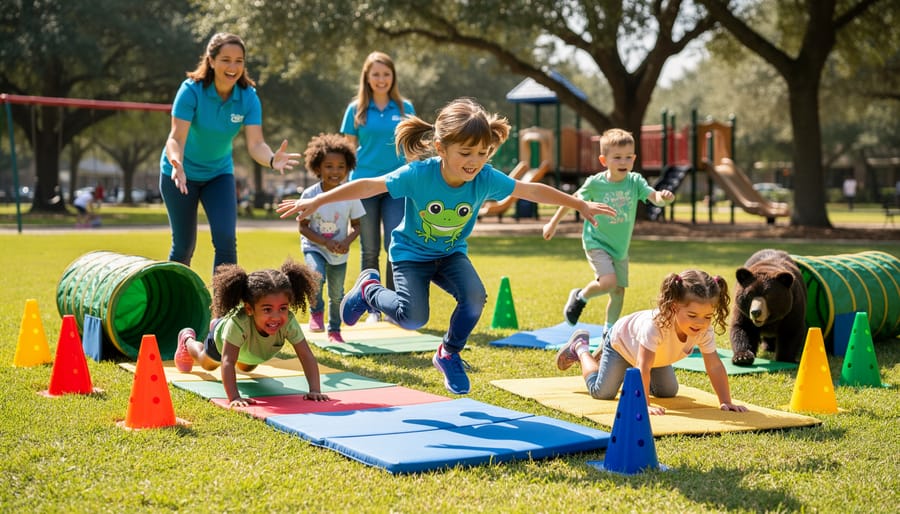
Turn your backyard or local park into an animal kingdom where your child builds serious strength without realizing they’re exercising. An animal walks obstacle course uses simple movements that mimic how different creatures move, bear crawls on hands and feet, frog jumps from a squat position, crab walks with belly facing up, and bunny hops with feet together. These aren’t just silly fun; each movement strengthens different muscle groups, improves balance, and develops the core stability that 4 and 5 year olds need for running, climbing, and everyday coordination.
Setting up takes five minutes with items you already own. Use pool noodles laid flat, hula hoops, garden stakes, or natural markers like rocks and sticks to define stations. Space them 10-15 feet apart, close enough to maintain interest but far enough to require real movement. Call out which animal to be at each station, and let kids move through the course in their own time. There’s no racing here; the goal is exploring how their bodies can move in different ways.
The best part? You can easily combine this with active vocabulary games by naming each animal and making its sound, or adding color recognition by assigning animals to different colored markers. Keep the course short, four to six stations works perfectly for maintaining attention and preventing fatigue.
3. Color Hunt Race, Combining Movement with Learning
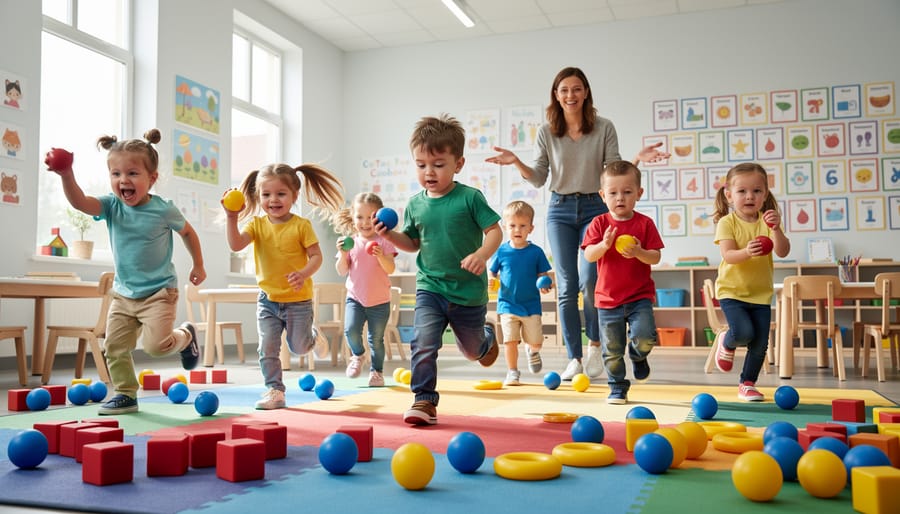
Color Hunt Race turns your backyard or park into an exciting learning zone where kids sprint, search, and sort all at once. You call out a color, “Find something yellow!”, and children dash off to bring back a dandelion, a tennis ball, or a fallen leaf. The beauty is how naturally it combines cardiovascular exercise with cognitive skills that preschoolers are actively developing.
Set up is wonderfully simple. Give each child a small bucket or bag, establish clear boundaries for the play area, and start calling colors. Young kids typically know their primary colors well at this age, but you can introduce secondary colors like purple or orange to gently expand their vocabulary. Call one color at a time, letting everyone succeed before moving to the next.
The running back and forth provides excellent cardio bursts while the searching builds visual discrimination skills. Kids practice following verbal directions and making quick decisions about what counts as “green” or “blue.” You can adjust the challenge by setting a timer, asking for multiple items of one color, or creating teams where children work together.
This game works particularly well in natural settings where colors abound. Grass, flowers, stones, and sticks offer endless possibilities without requiring any purchased equipment.
4. Freeze Dance Outdoors, Rhythm, Balance, and Giggles
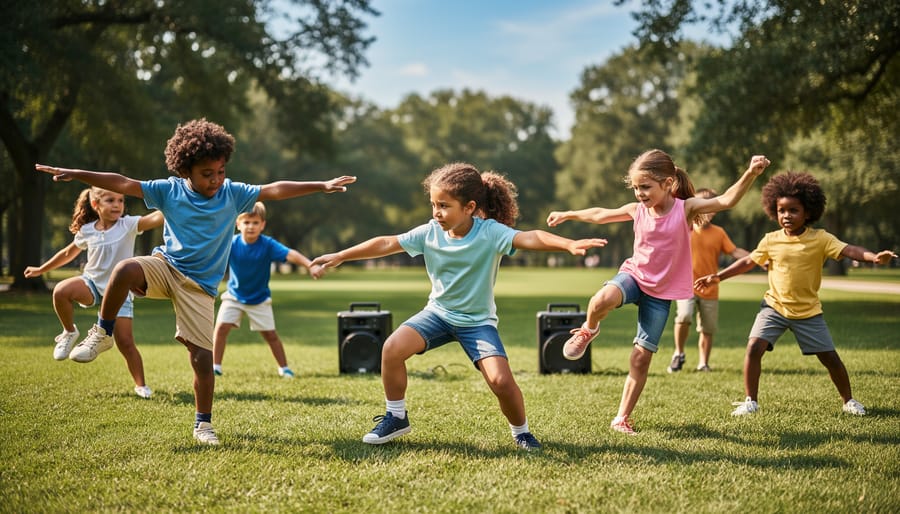
Freeze dance translates beautifully to outdoor spaces where kids have room to spread out and move freely without worrying about bumping into furniture. Set up a portable speaker or phone with a playlist of upbeat songs your preschoolers enjoy. When the music plays, children dance however they want, jumping, spinning, wiggling. When you pause the music, everyone freezes in whatever position they’re in.
The magic happens in those freeze moments. Holding a position requires balance and body control that 4-5 year olds are still developing. They become aware of where their arms and legs are in space, engage their core muscles to stay still, and practice the self-regulation skill of stopping an action mid-movement. These brief pauses help them understand their bodies better without feeling like exercise.
This game works brilliantly for mixed groups because there’s no wrong way to dance. High-energy kids can jump and twirl wildly, while quieter children can sway gently, everyone participates at their own comfort level. The rounds naturally last just a few minutes, perfect for short attention spans, and you can play multiple rounds with different energy levels.
Add silly challenges during freeze moments: “Freeze like a tree!” or “Freeze on one foot!” These variations keep the game fresh and give less confident dancers a playful goal beyond just stopping.
5. Simple Relay Races, Teamwork for Tiny Athletes
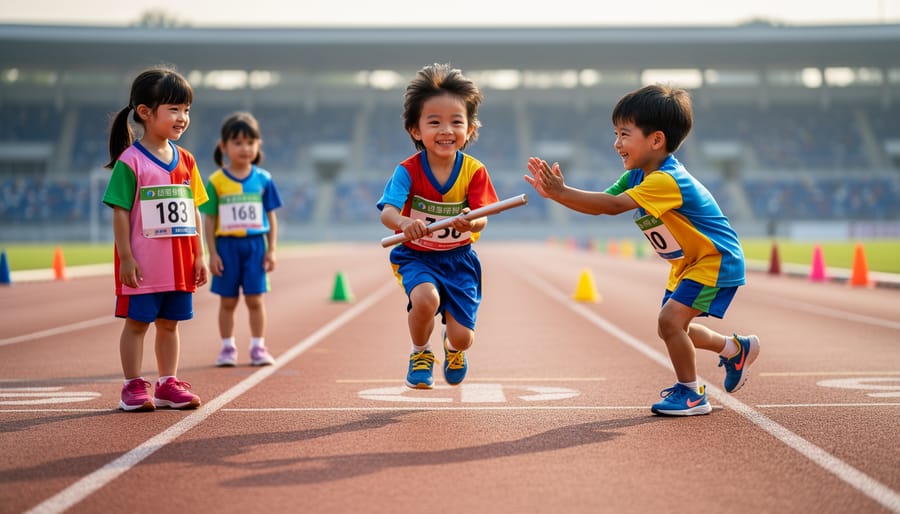
Relay races let 4 and 5 year olds experience teamwork without the pressure of real competition. At this age, the goal isn’t winning, it’s taking turns, following a simple sequence, and feeling proud of completing a task alongside friends.
Start with a ball carry relay. Each child holds a small ball (soccer ball, beach ball, or even a stuffed animal works) and walks or runs to a marker about 15 feet away, then returns to pass the ball to the next person. Keep distances short. If a ball drops, it’s no big deal, just pick it up and keep going. Celebrate every handoff with high-fives.
The beanbag balance adds a coordination challenge. Kids place a beanbag on their head or shoulder and walk carefully to the turnaround point. When the beanbag falls (and it will), they simply stop, replace it, and continue. This teaches body control and patience without frustration.
For pure giggles, try a waddle race where children hold a soft ball between their knees and waddle to the finish line. It’s silly, slow, and levels the playing field for all abilities.
Keep teams small, two to four kids per group, so no one waits too long. Avoid declaring winners. Instead, cheer for effort: “You carried that ball so carefully!” or “Great job helping your friend!” The real win is that every child gets multiple turns and feels part of something bigger.
6. Parachute Play, Cooperative Fun for Groups
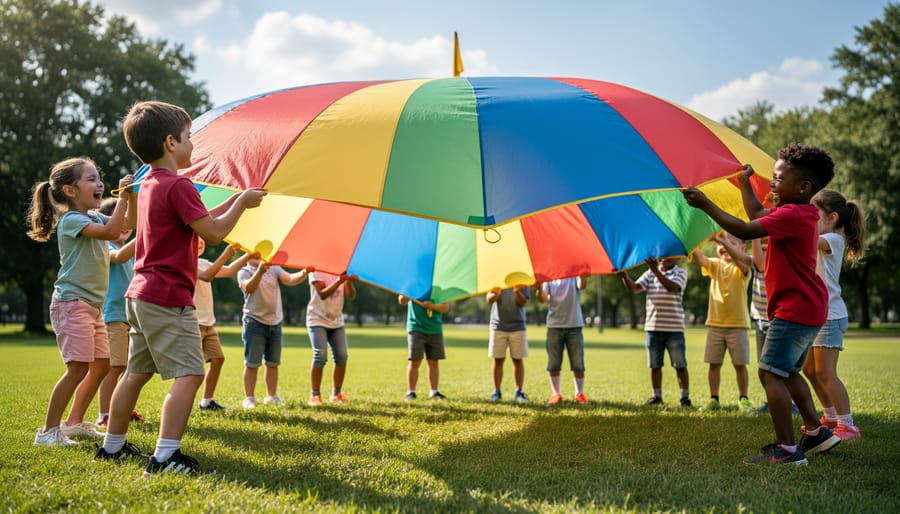
Parachute play transforms a simple piece of fabric into an engaging tool that teaches 4-5 year olds to work together. Unlike competitive games, every child contributes equally to making the parachute move, which builds confidence in less assertive preschoolers.
Start with the mushroom: everyone holds an edge, lifts the parachute high on “up,” pulls it down and sits on the edge on “down,” trapping air inside to create a colorful dome. Kids love crawling under before it deflates. This teaches timing and following group cues.
For popcorn, place lightweight balls or soft toys on the parachute. Children shake it to make items bounce like popping corn. Adjust the challenge by using more balls or changing the shaking speed. This builds arm strength and sustained attention.
Cat and mouse works well once kids grasp the concept: one child crawls under the parachute (mouse) while another stays on top (cat), with the group gently rippling the fabric. Keep rounds short, under 30 seconds, since sustained waving tires small arms quickly.
You don’t need an expensive play parachute. A king-sized flat sheet works for groups of four to six children. Outdoor space helps with excitement levels, though parachute play translates easily to gyms on rainy days. The key benefit isn’t the specific game, it’s practicing shared goals where everyone’s effort matters.
7. Shadow Tag, Classic Chase with a Twist
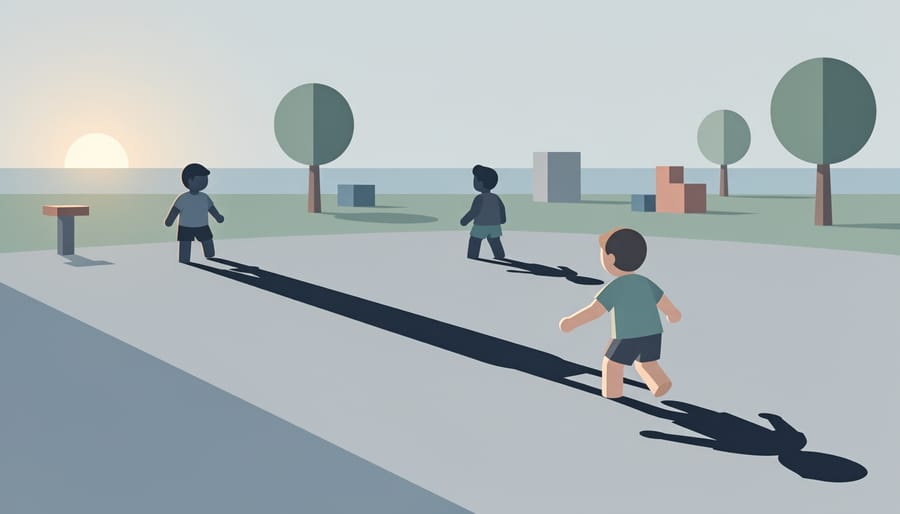
Shadow tag puts a clever spin on traditional chase games that works perfectly for preschoolers. Instead of tagging bodies, players try to step on each other’s shadows, which means no physical contact, fewer collisions, and less risk of accidental bumps that can upset sensitive four-year-olds.
The rules couldn’t be simpler: one child is “it” and chases others, trying to step on their shadows while everyone else tries to keep their shadows out of reach. Kids quickly discover they can make their shadows move by moving their bodies, which builds spatial awareness as they learn to track both their own shadow and others’ simultaneously.
This game shines during morning hours (around 9-10am) or late afternoon (4-5pm) when the sun sits lower in the sky and casts long, dramatic shadows that are easier for little ones to see and step on. Midday shadows shrink and nearly disappear, making the game frustrating rather than fun.
Shadow tag naturally encourages bursts of running, quick direction changes, and playful dodging, all excellent for cardiovascular fitness and agility. It’s also forgiving: if a child trips or needs a break, they can simply step into shade where their shadow vanishes and they’re temporarily “safe.” On rainy days when shadows disappear entirely, you can keep kids moving indoors with the other active games we’ve covered.
8. Bubble Pop Dash, Active Play That Never Gets Old

Blowing bubbles and chasing them down might sound too simple to count as real exercise, but watch a group of 4-5 year olds in action and you’ll see nonstop movement. Kids naturally run, jump, reach, and twist as they track floating bubbles, building cardiovascular endurance and hand-eye coordination without realizing they’re working out.
Make it more active by blowing bubbles at different heights. High bubbles encourage jumping and stretching, while low bubbles prompt squatting and lunging. Challenge kids to pop bubbles before they touch the ground, turning gentle drifting into an all-out sprint. You can also blow a stream of bubbles in one direction so children chase them across the yard.
The beauty of bubble play lies in its unstructured nature. There’s no winner, no strict rules, just kids moving freely and making their own choices about how to engage. This type of open-ended play lets children experiment with different movements, develop spatial awareness, and regulate their own activity level, skills that transfer to more structured games as they grow.
A simple bottle of bubble solution works perfectly, though bubble wands or machines create more bubbles for group play. On windy or rainy days, try indoor games for preschoolers that offer similar benefits in a controlled space.
Making Outdoor Game Time a Daily Habit
Building outdoor play into your daily routine doesn’t require perfect conditions or elaborate planning. The key is consistency, even if it’s just 15-20 minutes to start. Most 4-5 year olds need 60-180 minutes of active play daily, and outdoor games are one of the most engaging ways to meet that target. Pick a regular time that works for your schedule, right after breakfast, before lunch, or as an after-school release, and protect it as you would any other essential part of the day.
Rotate between structured games (like Red Light, Green Light or relay races) and free play to match your child’s mood and energy level. Some days they’ll thrive with clear rules and direction; other days they’ll need to run, explore, and make up their own games. Watch for signs: fidgeting and short attention often mean they need more movement, while frustration or tears might signal they need less structure or a simpler activity.
Don’t let weather or small spaces stop you. Rainy days are perfect for puddle jumping and freeze dance under a covered porch. Small yards work beautifully for shadow tag, animal walks, and color hunts. Even apartment balconies or parking areas can host bubble pop or parachute play. The physical activity guidelines align with broader kids health facts: daily outdoor movement builds not just coordination and strength, but also mood regulation, sleep quality, and long-term wellness habits. You’re giving your preschooler tools that last far beyond these early years.
Key Details to Know
Key Details to Know
Before heading outside, keep these practical points in mind to make game time smoother and more successful:
- Four and five year olds typically have attention spans of 8-15 minutes per activity, so plan to switch games or take short breaks rather than pushing through when interest fades.
- Outdoor play works best when scheduled at consistent times daily, ideally mid-morning or late afternoon when energy levels are naturally higher and the sun isn’t too intense.
- Simple props like sidewalk chalk, bubbles, a beach ball, and a basic parachute or large sheet cover most of the games in this list without requiring significant investment.
- Children this age need visual demonstrations more than verbal instructions, show them how to play first, then invite them to try alongside you.
- Weather between 50-80°F is ideal, but children can play comfortably outside year-round with appropriate clothing and shorter sessions in extreme temperatures.
These games thrive on repetition. Your child might want to play the same game for a week straight, and that’s perfectly normal. The familiarity builds confidence and lets them master new skills at their own pace, which matters far more than variety at this developmental stage.
Common Questions About Outdoor Games for Young Children
How much supervision do 4 and 5 year olds need during outdoor games?
Constant adult supervision is essential for this age group. You don’t need to hover over every movement, but you should always maintain visual contact and stay within quick response distance. Preschoolers can’t yet reliably assess risks like uneven ground, other children’s movements, or how fast they’re running toward obstacles. Position yourself where you can see the entire play area and intervene quickly if someone trips, collides, or wanders off. For group settings, one adult can typically manage 4-6 children during structured games, but outdoor environments with more variables may require closer ratios.
What if we only have a small backyard or no yard at all?
Most of these games adapt beautifully to small spaces, you can play Red Light Green Light in a driveway, do animal walks in a living room cleared of furniture, or freeze dance on a patio. Local parks, school playgrounds after hours, and even quiet parking lots work well for games needing more room.
Can I mix my 4-year-old with older siblings during these games?
Yes, with simple modifications. Older children can take leadership roles, demonstrate movements, or accept handicaps like hopping on one foot during races. The cooperative games like parachute play and bubble pop naturally work across ages without anyone feeling left out.
What do I do when my child refuses to go outside or participate?
Start with their interests, if they love animals, lead with animal walks; if they’re drawn to music, try freeze dance first. Sometimes children resist transitions, so giving a five-minute warning helps. Joining in yourself rather than directing from the sidelines often sparks their curiosity, and it’s perfectly fine to start with just 10 minutes outside rather than forcing a long session.
How do I handle different weather conditions?
Light rain actually makes games like color hunts more exciting with puddle-jumping added in, and freeze dance works great on hot days with a sprinkler running nearby. Skip outdoor play during extreme heat, thunderstorms, or when temperatures drop below what your child can handle with proper clothing, but don’t let “less than perfect” weather keep you inside, kids this age rarely mind conditions that adults find uncomfortable.
The beauty of these simple games is their flexibility. You’ll quickly learn which ones your specific children gravitate toward and how to adjust based on your space, weather, and group dynamics. Trust your judgment about safety while staying open to a bit of mess and spontaneity, that’s where the real fun happens for preschoolers.
These 8 outdoor games give your 4 and 5 year old exactly what they need right now: chances to run, jump, balance, and build confidence while having genuine fun. You don’t need expensive equipment or a huge backyard. Start with just one or two games this week, maybe Red Light, Green Light during your afternoon routine or a quick Color Hunt before dinner.
Every time your child plays outside, they’re strengthening muscles, improving coordination, and learning how their body moves through space. They’re also building social skills, practicing following directions, and discovering that physical activity feels good.
Which game will you try first? We’d love to hear which ones become favorites in your household. Get outside, play together, and watch your preschooler’s abilities grow with every giggle-filled session.