
Transform rainy days and cold mornings into opportunities for active play by rotating through games that match your preschooler’s energy level and developmental stage. Set up a simple indoor obstacle course using couch cushions, painter’s tape lines, and laundry baskets to get wiggles out when outdoor play isn’t possible. Keep a quick-grab bin of age-appropriate supplies like scarves for dancing, bean bags for tossing, and large building blocks near your main play area so you’re never caught unprepared. Choose activities that require minimal setup time, as preschoolers have short attention spans and need immediate engagement. Mix movement-based games like freeze dance or balloon volleyball with quieter activities like sorting games or sensory bins to balance high-energy bursts with calming transitions throughout the day. Most indoor games work best in 10 to 15-minute segments, allowing you to switch activities before restlessness sets in. The key is having a mental list of go-to options that require items you already own, making it easy to pivot when boredom strikes or weather keeps everyone inside unexpectedly.
Why Active Indoor Play Matters for Preschoolers
When you’re stuck inside with energetic three- to five-year-olds, it’s easy to reach for tablets or turn on the TV. But understanding why children need movement helps us see indoor active play as essential, not optional. During these crucial early years, physical activity does far more than tire kids out for naptime.
Active indoor games build the fundamental gross motor skills preschoolers need, from jumping and balancing to coordination and spatial awareness. These physical milestones create the foundation for everything from handwriting to sports participation later on. Even better, movement supports brain development in ways that sitting still simply can’t match. When little ones hop, dance, and climb, they’re literally building neural connections that support learning.
You’ll also notice that active play improves focus and attention, helping children settle into quieter activities afterward. This makes indoor games a smart strategy before homework time or meals.
With concerns about screen time recommendations constantly on parents’ minds, active indoor play offers a joyful alternative. Establishing healthy habits early sets children up for a lifetime of choosing movement over sedentary activities. The best part? Indoor games make staying active feel like pure fun, not exercise.
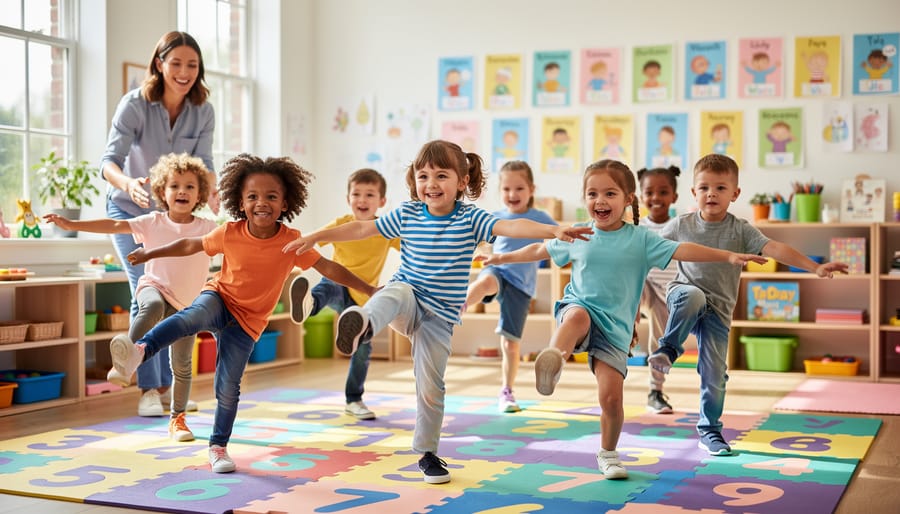
Movement Games That Build Coordination and Strength
Games That Need Minimal Setup
Sometimes the best games are the ones you can start right this second! These no-prep activities require zero planning and nothing more than your enthusiasm. They’re perfect for those moments when your little one needs to burn energy fast.
Freeze Dance is a preschooler favorite that never gets old. Simply play music and encourage your child to dance with wild abandon. When you pause the music, everyone freezes like statues. It’s fantastic for building body control and listening skills while getting giggles galore.
Simon Says gets those bodies moving when you focus on action-based commands. Try “Simon says hop on one foot,” “Simon says stretch to the sky,” or “Simon says wiggle like a worm.” This classic game teaches children to follow directions while sneaking in plenty of physical activity.
Follow the Leader transforms you into an adventure guide. March around the house doing different movements—walking on tiptoes, taking giant steps, or crawling like animals. Your preschooler copies everything you do, making it easy to control the energy level based on what your child needs.
The beauty of these games? You can play them anywhere in your home, for as long or short as needed. They’re your secret weapon for rainy days, before-dinner wiggles, or anytime your child needs to move their body and have fun.
Games With Simple Props You Already Have
You don’t need fancy toys to create amazing indoor adventures for your preschooler. Look around your home and you’ll discover endless possibilities for active play using everyday items.
Create an exciting obstacle course using couch cushions, pillows, and rolled-up towels. Set up stations where your child crawls under chairs, jumps over soft obstacles, and balances along a masking tape line on the floor. This builds coordination and gross motor skills while burning energy.
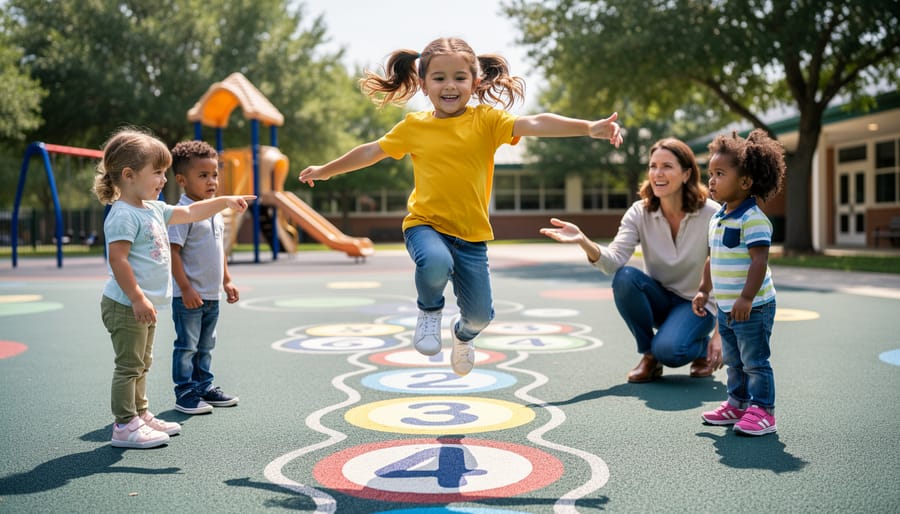
Transform your hallway into an indoor hopscotch court using painter’s tape or masking tape. Number the squares and let your little one practice counting while hopping. You can even make different patterns like shapes or letters for added learning.
Balloons make perfect targets for gentle indoor practice. Have your child toss balled-up socks or soft stuffed animals into laundry baskets placed at various distances. This develops hand-eye coordination and spatial awareness.
Set up a stuffed animal zoo by arranging toys around a room, then challenge your preschooler to deliver pretend food (bean bags or soft toys) to each animal. They’ll stay active while using their imagination.
These simple setups require minimal preparation but deliver maximum fun, keeping your preschooler moving and engaged even when you’re stuck indoors.
Calm-Down Movement Activities
After all that active play, preschoolers need time to settle down and refocus. These calm-down movement activities help little ones transition smoothly between high-energy games and quieter tasks while still keeping bodies engaged.
Try “Animal Stretches” where children imitate stretching cats, reaching giraffes, or folding turtles. This makes flexibility fun and approachable. You can also introduce simple yoga poses designed for young children, like tree pose, butterfly, or child’s pose. Use playful names and encourage them to hold each position while taking three deep breaths.
The “Slow-Motion Challenge” is another favorite. Ask children to move across the room as slowly as possible, or pretend to swim through honey or walk on the moon. This activity builds body control and awareness while naturally lowering energy levels.
“Simon Says Stretch” combines the classic game with gentle movements like touching toes, reaching for the sky, or making big arm circles. Keep the pace relaxed and focus on smooth, controlled motions.
These activities work perfectly before naptime, after exciting games, or anytime you notice energy levels getting too high. They teach children that movement isn’t just about running and jumping—it’s also about breathing, stretching, and listening to their bodies.
Learning Games That Get Kids Moving
Letter and Number Recognition Games
Turn learning letters and numbers into an active adventure with these movement-based games! Create a letter hunt by hiding alphabet flashcards around your living room and challenging your preschooler to find them in order while calling out each letter’s sound. This gets them moving while reinforcing early literacy skills.
Alphabet hopscotch puts a learning twist on the classic game. Use painter’s tape to create hopscotch squares on your floor, but write letters instead of numbers in each box. As children hop through, they practice letter recognition and sounds. You can make it more challenging by calling out specific letters for them to jump to.
Counting jumps combine physical activity with numeracy practice. Ask your child to do a certain number of jumping jacks, hops on one foot, or bunny jumps while counting aloud together. Start with small numbers and gradually increase as they get comfortable.
For a quieter option, try number freeze dance. Play music and when it stops, hold up a number card. Your child must freeze in a pose and perform that many movements, like five arm circles or three toe touches. These games prove that learning fundamentals doesn’t have to mean sitting still!
Color and Shape Learning Activities
Learning colors and shapes doesn’t have to mean sitting still with flashcards. Get your preschooler moving with these active indoor games that make education feel like playtime!
Start with a color sorting relay. Place colorful objects like toys, blocks, or even socks around the room, then set up buckets or bins labeled with different colors. Challenge your child to hop, skip, or tiptoe to collect items and sort them into the correct containers. Time them for an extra challenge or turn on music to make it feel like a dance party.
Shape dancing is another favorite that combines movement with learning. Cut out large shapes from construction paper and scatter them on the floor. Call out a shape and an action: “Jump to the circle!” or “Crawl to the triangle!” You can even play freeze dance where children must land on a specific shape when the music stops.
For a calmer activity, try matching games with a twist. Create duplicate sets of colored or shaped cards, hide them around the room, and have children race to find matching pairs. They’ll burn energy while developing memory skills and shape recognition.
These activities require minimal supplies and transform learning into an adventure that keeps little ones engaged and active indoors.
Songs and Rhymes With Movements
Music and movement naturally belong together, making action songs perfect for energetic preschoolers stuck indoors. Start with timeless favorites like “Head, Shoulders, Knees, and Toes” to get bodies warmed up while reinforcing body part recognition. “If You’re Happy and You Know It” lets kids clap, stomp, and shout while expressing emotions through movement.
For more dynamic options, try “The Hokey Pokey” to practice directional skills and coordination, or “Five Little Monkeys Jumping on the Bed” for counting practice combined with jumping. “Baby Shark” remains incredibly popular and gets little ones moving their arms in swimming motions while building rhythm awareness.
Create your own variations by adding new verses to familiar tunes, like “We’re Going on a Bear Hunt” where children climb imaginary mountains and wade through pretend rivers. Keep the energy flowing by letting children suggest movements, and don’t worry about perfect pitch. The goal is getting bodies moving while having fun together, building coordination and confidence through play that feels like pure entertainment.
Creating Your Indoor Activity Space
You don’t need a gymnasium to create an engaging activity space for preschoolers. With a bit of creativity and planning, any living room, basement corner, or classroom can become a fantastic play zone that keeps little ones moving and learning.
Start by choosing a space with enough room for children to spread their arms wide without touching walls or furniture. A cleared area of about 8×8 feet works well for most preschool activities. Remove breakable items, secure furniture with sharp corners, and check that the floor is free from small objects that could be tripping hazards. Soft surfaces like carpets or foam mats are ideal, but even hardwood floors work fine for many games.
Keep your setup simple and flexible. Instead of permanent equipment, opt for portable items you can easily store when playtime ends. Baskets or bins work wonderfully for quick cleanup, and rotating different toys and props every few days keeps activities feeling fresh and exciting. Consider designating specific containers for different activity types—one for movement games, another for quiet play—so you can quickly adapt to your child’s energy level.
These boundaries help children understand expectations while still having fun.
Worried about noise and mess? Set up your play space away from quiet areas when possible, and embrace washable materials. Lay down an old shower curtain or plastic tablecloth for messy activities, and establish a “cleanup song” routine that makes tidying up part of the fun. Remember, a little controlled chaos is perfectly normal and actually beneficial for young children developing their physical skills and confidence.
Even small apartments can accommodate indoor play. Think vertical by using doorway pullup bars for hanging activities, or simply push furniture against walls temporarily to maximize floor space.
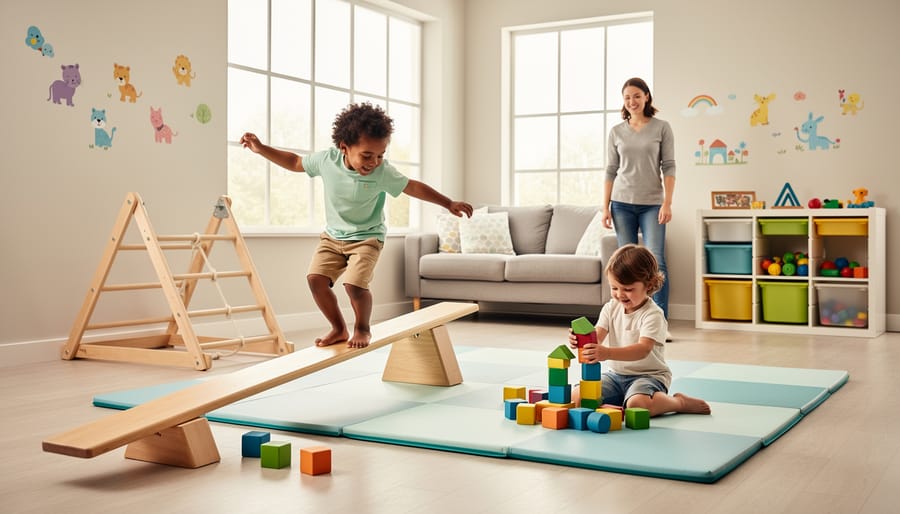
Making Indoor Active Play a Daily Habit
The secret to keeping indoor active play going strong is making it as natural as brushing teeth. Start by identifying the best times in your daily routine when energy levels need managing. Morning dance parties work wonders for burning off that early-day excitement before quiet activities. After-snack wiggle breaks prevent the afternoon slump and help little bodies digest. On rainy days, create a loose schedule alternating between active games and calmer pursuits every 30-45 minutes.
Getting siblings involved takes a bit of creativity, but it’s absolutely doable. Older children can be “coaches” for animal walks or lead obstacle courses they design themselves. Younger preschoolers love following their big siblings, even if they’re doing simplified versions. Adjust games by changing rules rather than separating kids – everyone can freeze dance, just at their own speed and style.
Keep things exciting without spending a dime by rotating games weekly rather than daily. Store some supplies out of sight for a few weeks, then bring them back as “new again” activities. Simple tweaks refresh familiar games: freeze dance becomes slow-motion dance, or the floor becomes hot lava instead of an ocean.
The goal is to make movement happen naturally throughout the day, not as special events. When active play becomes routine, children stop asking for screens and start asking what game comes next. Consistency matters more than perfection, so even 10 minutes counts as a win.
You don’t need a playroom full of equipment or a gymnasium to keep your preschooler moving and learning. The beauty of these indoor games is their simplicity. Most require nothing more than everyday household items, a bit of floor space, and your enthusiasm. Start small by choosing just one or two activities that match your child’s interests and energy level. As you both become comfortable, gradually add more games to your rotation.
The key is consistency, not perfection. Even 15 minutes of active play a few times throughout the day makes a real difference in your child’s physical development, mood, and sleep quality. By making movement fun and regular now, you’re helping establish active lifestyle habits that can last a lifetime. Remember, you’re not just filling time on a rainy day—you’re building a foundation for health and wellness.
Ready to discover even more ways to keep kids active? Visit the Active After School website for additional games, expert tips, and resources designed to make physical activity an enjoyable part of every child’s day.