
The best outdoor games for 10-12 year olds mix running, strategy, and teamwork, and the eight below do exactly that: Capture the Flag, Ultimate Frisbee, relay race challenges, Four Square, Sharks and Minnows with tag variations, a backyard obstacle course, kickball, and scavenger hunt adventures. Most need little more than a patch of grass, a ball, or some cones, and you can start playing in under ten minutes.
This age group sits in a sweet spot. Kids are strong and coordinated enough for real competition, but they still love silly twists and invented rules. They want to feel challenged, included, and in charge of the fun. Games that let them plan, negotiate, and lead tend to hold their attention far longer than simple chasing ever will.
Every pick here was chosen for easy setup, clear rules, flexible group sizes, and real fitness payoffs. If your group also enjoys games that sharpen the mind, our guide to active learning games pairs well with this list. Grab a ball, gather the crew, and pick your first game.
How We Chose These Outdoor Games for Tweens
Think of this as a curated list rather than a hands-on test. We built it by asking what actually works for kids in this in-between age. If you’ve already browsed our outdoor games for 4-5 you’ll notice these picks are a step up: more strategy, more speed, and nothing that feels babyish.
Every game on the list had to meet these standards:
- Active for everyone, so no one spends the whole game standing around.
- Easy to learn, with rules you can explain in a minute or two.
- Flexible group size, working for a handful of kids or a whole class.
- Minimal equipment, usually a ball, some chalk, or items from around the house.
- Inclusive of all skill levels, so beginners and sporty kids can play side by side.
- Fun enough that the kids ask for a rematch.
There’s a good reason we lean toward games that combine movement with strategy and teamwork. Kids between 10 and 12 are ready to plan ahead, read what other players are doing, and work as a group. They also care a lot about friendships and fairness. Games like these let them sprint, think, and cooperate all at once, which builds fitness and confidence together. Keep that in mind as you scan the list and pick your first game to try.
1. Capture the Flag: The Classic Team Strategy Game
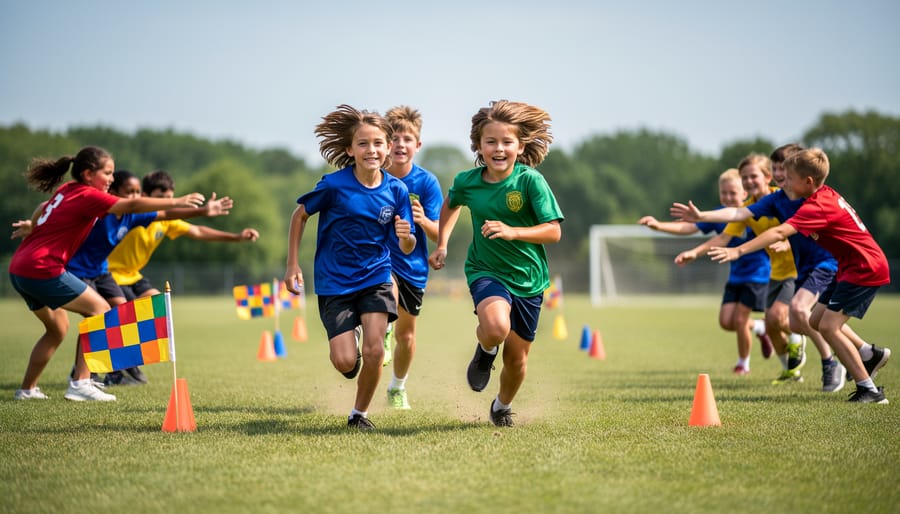
Capture the Flag is the game tweens ask for by name, and it’s easy to see why. Split the kids into two teams and give each team a flag (a bandana or a rolled-up towel works fine) placed at the back of its own territory. The goal is to sneak across the middle line, grab the other team’s flag, and carry it home without being tagged. Anyone tagged in enemy territory goes to a “jail” area until a teammate sprints in and frees them.
You’ll want an open field or large backyard, roughly the size of a basketball court or bigger, with a clear center line. Eight to twenty players is the sweet spot, though more kids simply means more strategy.
This game builds sprinting speed and quick direction changes, but the real magic is the planning. Kids huddle to decide who guards, who attacks, and who plays decoy. They learn to call out warnings and trust each other’s roles, which is teamwork in action.
To keep teams balanced, let the two teams swap a player or two after the first round, or have the kids pick teams by alternating picks instead of choosing friends. If you only have four to six kids, shrink the field, use one flag per team, and skip the jail by making tagged players do five jumping jacks before rejoining.
2. Ultimate Frisbee: Running, Throwing, and Fair Play

Ultimate Frisbee needs just one disc and an open stretch of grass, which makes it one of the easiest games on this list to start. Split the kids into two teams. Each team tries to pass the disc down the field to a teammate standing in the opposite end zone. The big rule: you can’t run while holding the disc. Catch it, plant a foot, and look for an open teammate to throw to. If a pass hits the ground or gets knocked down, the other team takes over right where it landed.
For beginners, shrink the field to about half the size of a football field and make it a strict no-contact game. Kids should reach for the disc, never for each other. You can also let new throwers take a few steps before passing, or allow a “second chance” throw after a drop.
The payoff is big. Constant sprinting into open space builds cardiovascular fitness, while catching and throwing sharpens hand-eye coordination. Best of all, traditional Ultimate has no referees. Players call their own fouls and sort out disagreements together, so kids practice honesty and fair play in a way that sticks. Try letting your tweens settle disputes themselves first and see how well they do.
3. Relay Race Challenges: Fun Twists on a Familiar Favorite

Relays are a tween favorite because the format is simple, but a few twists turn a basic sprint into a real challenge. They also scale to any group. Two kids can race the clock, and twenty can run in teams, so you never have to cancel the game because someone was missing.
Try these ideas:
– Bucket-carry relay: Each runner carries a cup or bucket of water to a finish line and pours it into a bigger container. The team with the fullest container wins.
– Obstacle relay: Set up cones to weave through, a hula hoop to hop in, and a jump rope to leap over before tagging the next teammate.
– Backward-run legs: Add a stretch where players run backward or crab walk. It looks silly and builds balance and coordination.
– Partner relays: Pairs can run with a balloon pressed between them or hop in a sack made from a pillowcase.
Most props already live in your house. Towels, laundry baskets, spoons, and tennis balls all make great gear. To keep things fair, mix speedy kids and slower ones on each team, and cheer for effort as loudly as you cheer for winning.
4. Four Square: Easy Setup, Big Fun on Any Pavement
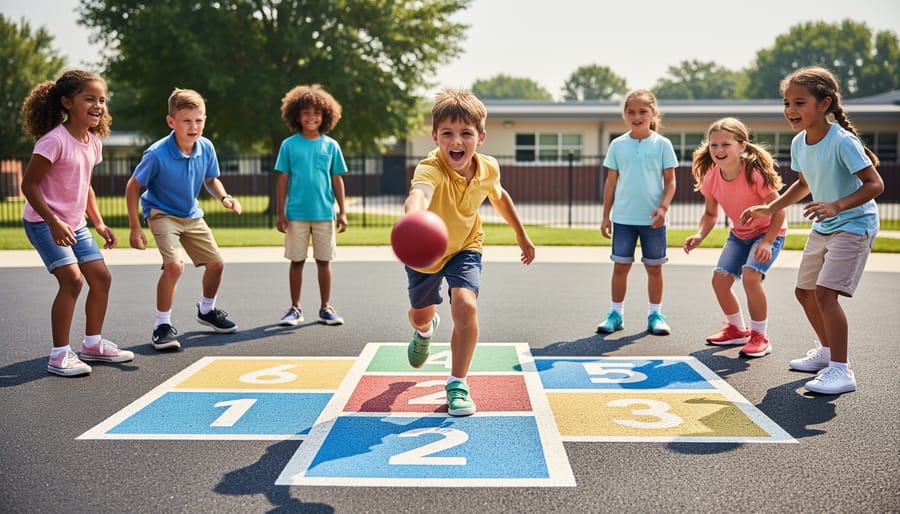
All you need for Four Square is a patch of pavement, some sidewalk chalk, and a playground ball. Draw a big square, about eight feet on each side, then split it into four equal boxes. Number them one through four, or label them King, Queen, Jack, and Joker if your group likes a little drama.
One player stands in each box, and the player in the top box serves. The server bounces the ball once in their own square, then bats it into another player’s square. That player has to hit it after one bounce and send it along to someone else. If you miss, step out of bounds, or hit it on a line, you’re out. Everyone shuffles up a box, and the next kid in the waiting line joins at the bottom. Nobody sits out for long, which keeps the whole crew engaged.
Tweens love Four Square because it sharpens reaction time and coordination while keeping the competition friendly. Try house rules like “cherry bomb” slams, “around the world” spins, or a rule that every serve must include a silly call-out.
5. Sharks and Minnows Plus Tag Variations: Fast-Paced Fun for Groups
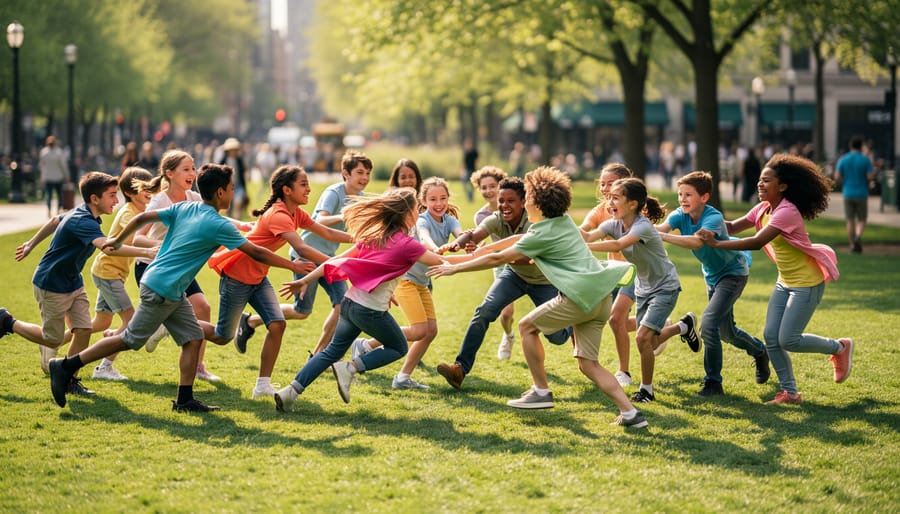
Sharks and Minnows is one of the easiest ways to get a big group sprinting at once. Pick one or two kids to be the sharks and send everyone else to one end of the play area as minnows. On “go,” the minnows try to run to the opposite end without getting tagged. Anyone tagged becomes a shark for the next round, so the sharks multiply and the minnows have to dodge and weave. The last minnow standing wins and starts as the next shark.
Once your group knows the rhythm, mix in a few tag twists:
– Freeze tag: Tagged players freeze in place until a teammate crawls under their legs or gives a high five to free them. It rewards teamwork and quick decisions.
– Flashlight tag at dusk: The tagger holds a flashlight and “tags” players by shining the beam on them. It’s a big hit when the light fades.
– Blob tag: Tagged players link hands with the tagger, and the “blob” grows as it chases everyone else.
Safety comes first with fast games. Choose a flat, open space free of holes, rocks, and hard obstacles, and mark clear boundaries with cones, chalk, or sticks. Remind kids that stepping out of bounds means they’re tagged, and keep play away from roads and water.
6. Backyard Obstacle Course: Let Kids Design the Challenge
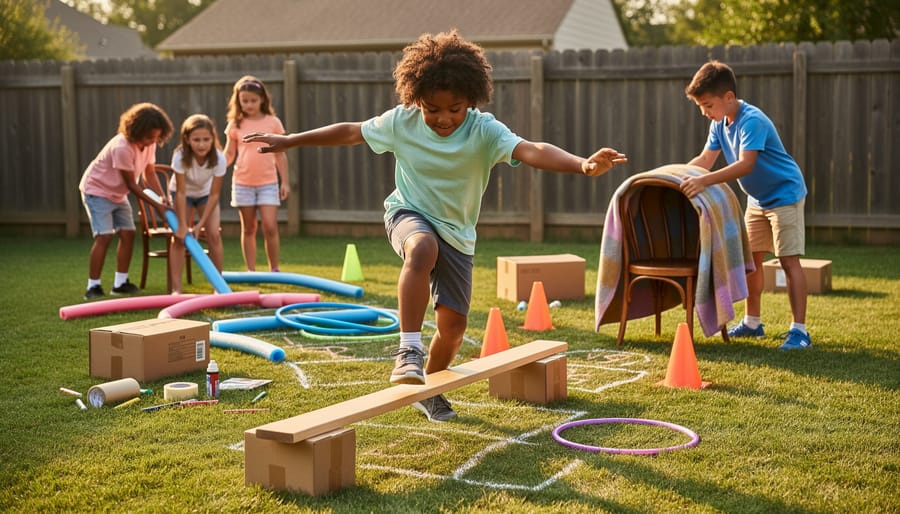
Give kids a pile of simple gear and a few minutes, and they’ll build a course that’s tougher than anything you’d plan for them. Grab cones, hula hoops, jump ropes, and pool noodles, then let them lay out stations: hop through the hoops, weave around the cones, balance along a rope line, and duck under a noodle held between two chairs.
Once the course is built, bring in the stopwatch. Each child can chase a personal best rather than racing a sibling or classmate, which keeps things friendly and gives every skill level a real goal. Writing down times on a scrap of paper makes progress easy to see.
Adjusting difficulty is simple. Widen the cone spacing for beginners, or ask older kids to carry a ball while they move. You can also add a strength station like bear crawls or 10 jumping jacks. Everyone gets to feel successful because the challenge grows with them.
7. Kickball: A Team Sport Everyone Can Join
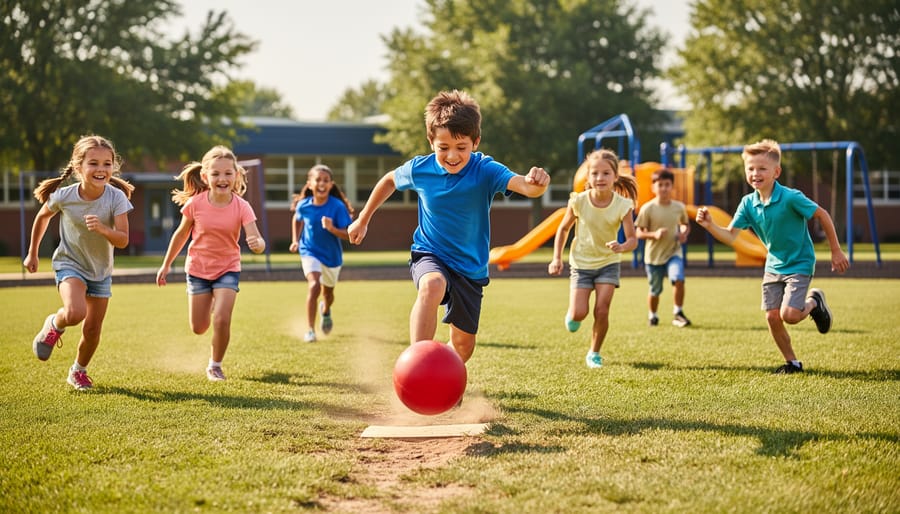
Kickball is baseball’s friendlier cousin, and it works for nearly everyone. Instead of a bat, the “batter” kicks a rubber playground ball rolled in by the pitcher, then runs the bases while the other team tries to catch the ball or tag runners out. Set up four bases in a diamond, split into two teams, and you’re ready to play.
What makes kickball great for 10-12 year olds is how many ways there are to contribute. Some kids love the big kick, others shine at catching, and some are the loudest cheerleaders on the sideline. Everyone gets to run, and nobody needs special skills to join in.
For smaller groups, try “everybody fields.” The kicking team sends up one kicker at a time while every other player spreads out in the field, so no one is stuck waiting. You can also let the kicker choose the pitcher, which turns that role into a strategy move. Keep a few ideas handy for wet weather too, like these rainy day indoor games so the fun never stops. Staying active also supports the bigger picture of kids health facts that parents care about.
8. Scavenger Hunt Adventures: Moving, Thinking, and Exploring
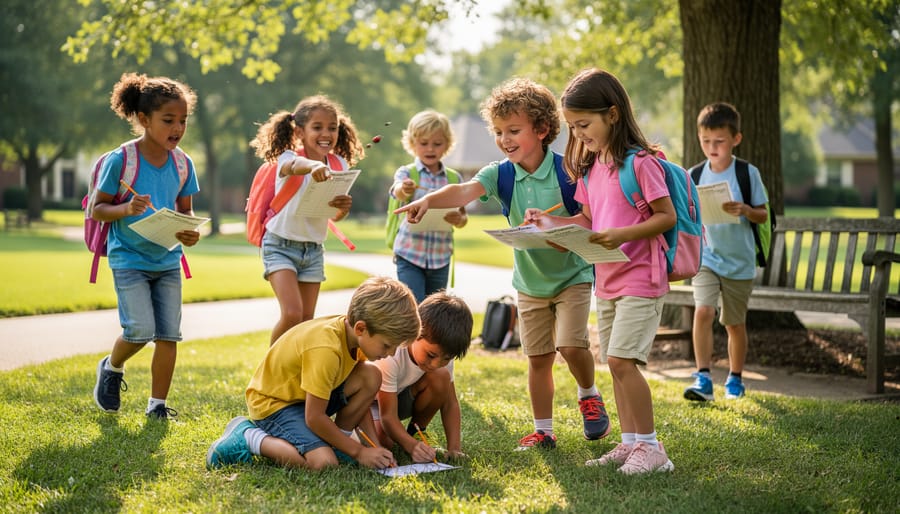
A scavenger hunt turns a walk around the yard, park, or block into a mission, and tweens love a mission. Hand each team a checklist, a set of riddle-style clues, or a phone for snapping photos instead of collecting items. Photo hunts are great for neighborhoods and school grounds because nothing gets picked up or left behind.
The movement sneaks in without anyone noticing. Kids walk, jog, and double back to check a clue, all while working through puzzles together. Ten- to twelve-year-olds enjoy writing clues as much as solving them, so let one team hide the trail for another.
Simple themes keep setup easy:
– Colors: find something red, something blue, something that’s three different shades of green.
– Shapes: spot a circle, triangle, or rectangle in signs, windows, and leaves.
– Nature finds: a feather, a smooth rock, a leaf with jagged edges, an insect home.
Educators will like how flexible this is. You can fold in a lesson on plants or local history, and mixed-age groups work well when older kids pair up with younger ones and read the clues aloud. Set clear boundaries, agree on a return time, and everyone wins.
Common Questions About Outdoor Games for 10-12 Year Olds
Parents and educators often ask the same handful of questions when they start planning more active play. Here are quick, practical answers.
What if my child doesn’t like competitive games?
Lean on cooperative options like the backyard obstacle course or a scavenger hunt, where kids chase personal bests or work together instead of beating each other. You can also drop the scorekeeping in games like kickball and just focus on playing.
How can I adapt games for kids with different abilities?
Change the rules, not the child’s role. Shrink the field, slow the pace with walking relays, give extra turns, or let kids pick the job that suits them, such as pitching, cheering, or being the clue keeper.
What if the weather isn’t perfect?
Light drizzle is great for scavenger hunts and relay challenges, while a dry driveway or patio works for four square. Skip anything that makes the ground slippery, and move indoors when it’s stormy.
How do I get tweens off their screens?
Let them choose the game and run it, since tweens love having a say. Starting with a quick, high-energy option like Sharks and Minnows tends to pull the group in fast.
As for how much activity kids this age need, a good rule of thumb is to aim for around an hour of movement most days. It doesn’t have to happen all at once. A twenty-minute game after school and a weekend adventure add up quickly, and it counts even better when the kids are laughing the whole time.
Your Next Step: Pick a Game and Get Everyone Playing
Pick one or two games from the list and try them this week. Let the kids vote on what to play first, because kids who help choose are far more likely to show up ready to run. Don’t worry about getting every rule perfect. A game that gets everyone laughing and moving beats a flawless one that nobody wants to play again.
Start small, keep it playful, and watch how quickly a backyard or schoolyard fills with energy. For more active play ideas, keep exploring the site and join our newsletter so fresh games land right in your inbox.