
You can build a stronger vocabulary in children through movement-based games that combine physical activity with word learning, and most take just 15 to 20 minutes with materials you already have at home. These games work because they activate multiple learning pathways at once: when kids jump to spell words, race to match synonyms, or act out new vocabulary, their brains form stronger memory connections than sitting still with flashcards ever could.
The challenge with traditional vocabulary practice is simple: it’s boring. Children tune out after a few minutes of worksheets or rote memorization. But when you transform word learning into an active game, everything shifts. Suddenly kids are begging for one more round, and they’re absorbing new words without realizing they’re studying.
Parents and educators who’ve tried these methods report remarkable results. Children remember words longer, use them in conversation naturally, and actually look forward to vocabulary practice. The secret lies in making the body part of the learning process. A 2025 study from the Journal of Educational Psychology found that children who learned vocabulary through movement retained 40% more words after two weeks compared to those using static methods.
The games ahead require no special training or expensive materials. You’ll find options for different energy levels, space constraints, and age groups. Whether you have a wiggling kindergartener who can’t sit still or a tween who thinks vocabulary practice is beneath them, there’s a game here that will work. Let’s get your kids moving and their vocabularies growing.
Why Active Vocabulary Games Work Better
When children move while they learn, their brains form stronger, more lasting connections to new words. Research in kinesthetic learning shows that physical activity increases blood flow to the brain, which enhances focus, memory encoding, and information retrieval. Instead of passively hearing or reading vocabulary words, kids who jump, run, or act out meanings create multiple memory pathways that make recall easier and faster.
The science behind this is straightforward: movement activates different brain regions simultaneously. When a child learns the word “soar” while leaping into the air, they’re not just memorizing a definition. They’re experiencing the sensation, engaging motor neurons, and linking the physical action to the word’s meaning. This multi-sensory approach creates what neuroscientists call embodied cognition, where the body’s movements help the mind understand abstract concepts.
Traditional sedentary vocabulary practice often feels like work to children, leading to resistance and shorter attention spans. Active vocabulary games flip this dynamic entirely. Kids stay engaged longer because they’re having fun, and the physical component addresses their natural need to move. You’re essentially solving two challenges at once: building stronger language skills while meeting daily physical activity recommendations.
Parents and educators who’ve switched to movement-based vocabulary activities report noticeable improvements in both word retention and enthusiasm for learning. Children ask to play “one more round” instead of complaining about boring homework. The combination of laughter, movement, and learning creates positive associations with vocabulary building that extend well beyond any single game session.
Tools and Materials You’ll Need
You probably already have everything you need to get started with active vocabulary games. Most materials are simple household items that can be used in countless creative ways.
Essential Indoor Materials:
- Index cards or cardstock for flashcards (3×5 inch works perfectly)
- Soft foam ball or beanbag for tossing games
- Masking tape to create floor patterns and boundaries
- Whiteboard or large paper for group activities
- Timer or stopwatch (your phone works great)
Outdoor Essentials:
- Sidewalk chalk for creating game boards and word grids
- Jump rope for movement-based word practice
- Hula hoop to mark zones or create word circles
- Playground ball for throwing and catching vocabulary games
Optional Extras:
- Laminator for reusable flashcards (or use clear packing tape)
- Colorful markers to make words more engaging
- Small prizes or stickers for motivation
- Portable speaker for music-based vocabulary activities
Don’t feel pressured to buy anything new. Start with what you’ve got, even a crumpled piece of paper and a marker can launch an effective vocabulary game. The movement and engagement matter far more than fancy supplies. As you discover which games your kids love most, you can gradually add materials that expand those favorites.
Safety Considerations for Active Vocabulary Games
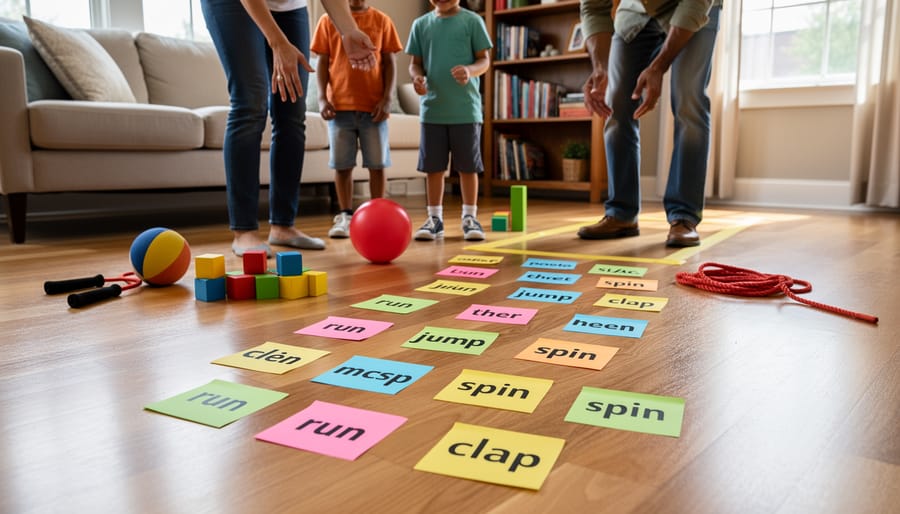
Before launching into active vocabulary games, take a few minutes to create a safe environment where kids can move freely without worry. Clear furniture and obstacles from your play area, leaving at least six feet of open space in all directions. For outdoor games, scan the ground for rocks, sticks, or uneven surfaces that could cause trips or falls.
Supervision matters more than you might think. An adult should always be present, especially when children are running, jumping, or playing games that involve throwing objects. Position yourself where you can see all participants clearly. For larger groups of kids, consider having a second adult or teenager help monitor the activity.
Choose movements that match your child’s age and coordination level. Five-year-olds do well with simple actions like hopping, clapping, or touching their toes. Older kids aged ten and up can handle more complex sequences like spinning, lunging, or catching objects while running. Watch for signs of fatigue, and build in regular water breaks.
Indoor games require extra care with ceiling height and fragile items. Keep jumping activities low to the ground, and move breakable decorations or electronics to another room. If you’re short on space, switch to activities that emphasize stretching, balancing, or seated movements rather than running.
For outdoor settings, check weather conditions before starting. Avoid playing on wet grass or pavement where kids might slip. Hot days call for shade and frequent hydration, while cold weather means layering clothing appropriately. Keep a basic first aid kit nearby, even for minor scrapes.
Step-by-Step: Implementing Active Vocabulary Games
Step 1: Choose Age-Appropriate Vocabulary Words
Start by matching your word choices to what children already understand and can build upon. For ages 5-7, focus on concrete nouns and simple action verbs they encounter daily: “jump,” “toss,” “happy,” “friend.” These foundational words connect easily to physical actions and emotions they experience.
Children aged 8-10 can handle more abstract concepts and compound words. Select vocabulary like “cooperate,” “explain,” “imagine,” or “discover.” These words stretch their thinking while remaining accessible through movement demonstrations.
For ages 11-12, introduce subject-specific terminology and words with multiple meanings. Try “analyze,” “perspective,” “adapt,” or “strategy.” These advanced learners benefit from vocabulary that connects across subjects, linking their physical education time to science, social studies, and literature.
Pull words from their current reading materials, upcoming school units, or standardized test prep lists. Avoid choosing more than 5-8 new words per session. Children retain vocabulary better when they can practice each word through multiple physical repetitions rather than rushing through dozens of terms once.
Step 2: Set Up Your Active Learning Space
Clear at least 10 feet of open floor space for your active learning area. Push furniture against walls, remove sharp-edged objects, and eliminate tripping hazards like loose rugs or scattered toys. Check that overhead light fixtures won’t interfere with jumping or reaching movements.
For outdoor setups, choose level ground away from traffic, pools, or other hazards. Scan the area for sticks, rocks, or uneven surfaces that could cause falls. Define clear boundaries using cones, chalk lines, or natural landmarks so children know where the play area begins and ends.
Keep vocabulary materials within easy reach but off to the side. Place flashcards, word lists, or props on a nearby table or bench where they won’t get trampled during active play. Position yourself where you can supervise the entire space and step in quickly if needed.
Test the space with a quick run-through before bringing children in.
Step 3: Introduce the Game Rules
Gather everyone in a circle and demonstrate the game yourself first. Show each movement slowly while saying the vocabulary word, making it clear and exaggerated so children can easily follow. Break down complex actions into simple steps: “First we hop, then we clap, then we say the word.”
Ask a volunteer to try it with you before the whole group starts. This peer demonstration helps kids visualize success and builds confidence. Check for understanding by asking, “Can someone tell me what we do when I hold up this card?” Answer questions before anyone moves.
Keep rules to three or four main points maximum. Too many instructions overwhelm young learners and kill momentum before you begin.
Step 4: Start with Simple Movements
Begin with movements that children already know and can perform confidently. Pair each vocabulary word with a single, clear action: jump when saying “leap,” reach up for “tall,” or spin for “rotate.” This one-word, one-movement approach builds confidence quickly.
Keep initial sessions short, five to ten minutes, with just three to five vocabulary words. Children master the words faster when they’re not overwhelmed. Watch for signs that kids are comfortable: they’re performing movements without hesitation and calling out words confidently.
Once everyone’s comfortable with basic patterns, add slight variations. Have children say the word while moving, then freeze and define it. Or alternate between fast and slow movements using the same word. These small tweaks maintain engagement while reinforcing the vocabulary-movement connection you’ve established.
When kids can recall and act out your starter words without prompting, they’re ready for more challenging activities.
Step 5: Progress to More Complex Activities
Once children confidently handle basic vocabulary games, layer in challenges that demand more from both their bodies and brains. Introduce relay races where teams spell words letter-by-letter while running, or vocabulary scavenger hunts that require decoding clues before sprinting to the next station.
Combine three or four different movements in a single game, jumping to synonyms, hopping to antonyms, running to definitions, so kids must process multiple concepts while staying physically active. Increase vocabulary lists from five words to ten or fifteen, pushing memory retention while maintaining the movement element.
Team-based activities work brilliantly at this stage. Try vocabulary charades races where one child acts out a word while teammates guess and perform a physical task for each correct answer. Partner spelling challenges that require synchronized movements between two children add complexity without overwhelming individual learners. These advanced games build both language skills and social cooperation while keeping energy levels high.
10 Active Vocabulary Games to Try Today
Here are ten games you can start using this week to make vocabulary practice an active adventure:
- Vocabulary Relay Races: Teams sprint to word stations, define the term, then race back (builds cardiovascular endurance while reinforcing definitions)
- Jump & Spell: Children jump rope or on a trampoline while spelling words aloud (combines coordination with letter sequencing)
- Synonym Simon Says: Leader calls out movements using varied vocabulary like “sprint” instead of “run” (teaches word relationships through whole-body responses)
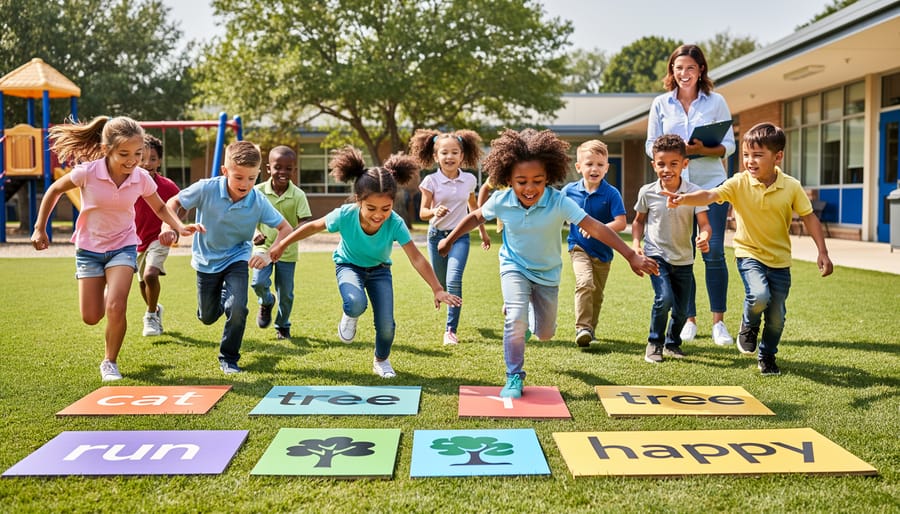
- Vocabulary Hopscotch: Chalk grid features words instead of numbers; kids hop and use each word in a sentence (develops balance and contextual understanding)
- Action Word Charades: Players act out verbs and adjectives without speaking while others guess (strengthens comprehension of descriptive language)
- Alphabet Ball Toss: Toss a ball back and forth, naming words starting with each letter in sequence (improves hand-eye coordination and quick recall)
- Vocabulary Scavenger Hunt: Children search indoor or outdoor spaces for items matching vocabulary cards (encourages problem-solving and real-world word connections)
- Word Category Freeze Dance: Music plays while kids dance; when it stops, call out a category and kids shout words that fit (builds flexibility and categorical thinking)
- Obstacle Course Definitions: Set up stations where kids complete a physical challenge then define a word to advance (combines strength-building with language precision)
- Vocabulary Tag: The person who’s “it” must correctly use a vocabulary word in a sentence before tagging someone (adds language practice to classic active play)
Each game adapts easily to your available space and materials. Vocabulary Relay Races work beautifully with just index cards and an open area. Write words on cards, place them at the far end of your space, and have kids sprint to grab one, read it aloud with the definition, then run back to tag the next teammate. For younger children (ages 5-7), use 8-10 simple words like “gigantic,” “tiny,” or “stumble.” Older kids (ages 10-12) can handle 15-20 words with more complexity like “extraordinary,” “hypothesis,” or “accumulate.”
Jump & Spell transforms a basic physical skill into language practice. As children jump, they spell words one letter per jump, which creates a physical memory of each word’s structure. Start with three-letter words for beginners and progress to longer, multi-syllable words as skills develop. You can add difficulty by having them spell words backward or asking them to define the word after spelling it.
Vocabulary Scavenger Hunt brings learning into the real world. Write words like “rectangular,” “smooth,” “fragrant,” or “transparent” on cards. Kids search for objects matching these descriptions, take photos or bring back items (when appropriate), then explain their choices. This game works equally well in backyards, parks, classrooms, or even grocery stores during errands.
For Obstacle Course Definitions, create simple stations using household items. Kids might army-crawl under a table, hop through hula hoops, balance on a line of tape, then stop at a word station. They read the word, provide a definition, and use it in a sentence before moving to the next physical challenge. This format keeps energy high while reinforcing multiple aspects of vocabulary knowledge simultaneously.

Verifying Progress and Measuring Success
Tracking vocabulary growth doesn’t require formal tests that might undermine the playful spirit of active learning. Instead, keep a simple notebook where you jot down words your child uses correctly in conversation, especially when they naturally incorporate vocabulary from recent games. Notice when they choose precise words over generic ones, saying “sprinted” instead of “ran fast” or “enormous” instead of “very big.”
Create a visual progress wall where children add a sticky note for each new word they’ve mastered, decorated with a small drawing of the movement they associate with it. This tangible display motivates kids while giving you a clear picture of expanding vocabulary. For more structured assessment, record a casual conversation every two weeks and compare the variety and complexity of words used over time.
Watch for application beyond game time. Does your child now describe playground activities with richer language? Are they using new words when telling stories at dinner? These real-world moments prove retention better than any quiz. You can also revisit games from several weeks ago; if children remember both the words and movements without prompting, the learning has stuck.
For educators working with groups, notice which children confidently demonstrate word-movement combinations for peers versus those who need reminders. Pair struggling learners with those who’ve mastered words for peer teaching opportunities that benefit both children while giving you insight into who needs additional practice.
Common Questions About Active Vocabulary Games
How much time should I dedicate to active vocabulary games each day?
Start with 10-15 minutes per session, three to four times a week. This frequency allows children to stay engaged without feeling overwhelmed, and you can extend sessions to 20-30 minutes as kids become more enthusiastic about the activities.
Can these games work indoors with limited space?
Absolutely. Many vocabulary games adapt perfectly to small spaces using modified movements like reaching, bending, or stepping in place rather than running. Clear furniture from a living room or use a hallway, and focus on games like vocabulary freeze dance or stationary action cards.
What if my child resists or seems uninterested in vocabulary games?
Let them choose the first game or pick their favorite movements to pair with words. Children engage more readily when they have ownership over the activity, and competition with siblings or friends often sparks interest in reluctant learners.
How do I manage active vocabulary games with multiple children at different skill levels?
Assign each child words that match their ability level while playing the same game together. Older children can work with complex vocabulary or definitions while younger ones practice simpler words, and you can pair them as teams where the older child helps the younger one.
Parents often worry about integrating these games into existing homework routines, but active vocabulary games actually complement traditional learning methods rather than replacing them. Use them as a break between homework assignments or as a reward after completing written work. Teachers have found that dedicating one or two physical education sessions per month to vocabulary-based movement activities reinforces classroom lessons while meeting fitness requirements.
Weather constraints need not derail your plans. Rainy days call for indoor modifications, and extremely hot days mean shorter outdoor sessions in shaded areas with water breaks. The flexibility of these games means you can adapt them to any environment or schedule constraint without losing their educational value.
Step-by-step process
Start by gathering your materials in one spot. Collect flashcards, markers, balls, and any props you’ll use. Choose 10-15 vocabulary words appropriate for your child’s age and current skill level.
Next, prepare your space. Clear furniture from indoor areas or mark boundaries outside with chalk or cones. Check for tripping hazards and ensure adequate room for running and jumping movements.
Explain the game rules clearly before beginning. Demonstrate each movement yourself, then have children practice once slowly. Confirm everyone understands the vocabulary-movement connections.
Begin with your simplest game choice. Play for 10-15 minutes, watching how children respond. Pause to review words they struggle with and celebrate successes immediately.
After completing one game, assess retention quickly. Ask children to use three learned words in sentences or define them. This reveals which vocabulary stuck and which needs reinforcement.
Gradually increase complexity over subsequent sessions. Add more words, combine multiple movements, or introduce team elements. Keep sessions under 30 minutes to maintain enthusiasm and energy levels.
verification
Track your child’s vocabulary growth by keeping a simple weekly log of words they use confidently in conversation. Listen for the target words appearing naturally during play, meals, or bedtime stories, not just when prompted. This spontaneous use signals genuine learning rather than mere memorization.
Create quick informal checks by asking your child to explain a word in their own terms or use it in a different sentence than the one from the game. If they can do this comfortably, the word has moved into their active vocabulary.
For classroom settings, observe group discussions and writing samples over two to three weeks. You should notice the new vocabulary appearing in unrelated activities, which confirms the words have transferred beyond the game context.
Photography works brilliantly for younger children: ask them to take pictures of things that match their vocabulary words throughout the week. Their ability to make these connections independently shows comprehension.
Set realistic expectations: seeing three to five new words genuinely integrated into regular speech each week represents solid progress. Retention matters more than the number of words introduced.
Active vocabulary games transform language learning from a sit-still task into an adventure that gets kids moving, laughing, and genuinely excited about words. You’re not choosing between physical fitness and education, you’re combining them into something more powerful than either alone.
The beauty of these games? You don’t need fancy equipment or elaborate setups. Start small. Pick one game from this guide that fits your space and time. Maybe it’s Word Tag in the backyard tomorrow afternoon, or Vocabulary Charades during indoor recess. Watch how quickly children absorb new words when their whole bodies are involved in the learning process.
As you incorporate more movement-based vocabulary activities into your routine, you’ll notice improvements extending beyond language skills. Children develop better coordination, burn off energy constructively, and associate learning with positive, active experiences rather than passive memorization.
The words your children learn today become the thoughts they express tomorrow. Make that learning process joyful, active, and memorable. Get outside, get moving, and watch vocabulary come alive in ways that stick with them for years to come.